天文 Astronomy

Seeing “things”? Lowell’s “Mars Canal Map” and Times report on “Life on Mars” (1906)

NASA Mars Times 1906

The idea that Mars is not just a star or a planet like others began when the 17th century Italian astronomer Giovanni Cassini discovered with his telescope the rotation period of Mars (24h 40′) similar to Earth’s, as well as its unusual surface markings. Two centuries later another Italian astronomer Giovanni Schiaparelli claimed in 1877 to have discovered a network of “canali” (channels, not canals) and seas on Mars. Inspired by Schiaparelli, American amateur astronomer Percival Lowell published a book in 1906 titled “Mars and its Canals” which won him acclaims and awards up to his death in 1916, along with some critics. Lowell claimed to have discovered over 550 canals along with “oases” which served as nodes as the planet’s irrigation system. The idea of life and civilization in Mars was so popular that Lowell’s claims went largely unchallenged in public despite no astronomers could actually observe them. His claims were disproved definitively only after the 1960s when NASA spacecrafts captured the true images of the planet.

More on Lowell and his contempories: https://qz.com/…/when-reporters-accidentally-wrote-science…/

First image: “Explore Mars Trek” from https://mars.nasa.gov/maps/

How did Lowell in 1906 see all the Martian canals and oases which never existed? And how did other scientists a century ago accept his claims despite they could not observe them?

It is amazing how our mind can make us see all kind of things. The Buddhists like to tell the story of the “rope” and the “snake”. Or inversely, not seeing things which are staring in your face, like all the holocaust denials, Nanking-massacre denials, climate change denials and the “alt-facts” these days…
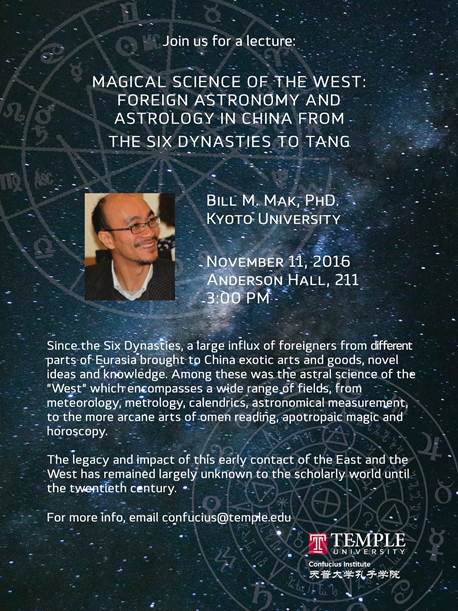
LECTURE [11/11]: MAGICAL SCIENCE OF THE WEST: FOREIGN ASTRONOMY AND ASTROLOGY IN CHINA FROM THE SIX DYNASTIES TO TANG

Lecture by Dr. Bill M. Mak- Associate Professor at Kyoto University

Date: Friday, November 11, 2016, 3:00 pm

Venue: Temple University, 211 Anderson Hall, 1835 N. 12th Street, Philadelphia

Details: https://events.temple.edu/magical-science-of-the-west-foreign-astronomy-and-astrology-in-china-from-the-six-dynasties-to-tang

Since the Six Dynasties, a large influx of foreigners from different parts of Eurasia brought to China exotic arts and goods, novel ideas and knowledge. Among these was the astral science of the “West”, a highly idiosyncratic body of astronomical knowledge including meteorology, metrology, calendrics, astronomical measurement, to the more arcane arts of omen reading, apotropaic magic and horoscopy. The new “astral science” of the West was drastically different from the Chinese’s and became highly sought after by the progressive rulers and elites. The legacy and impact of this early contact of the East and the West has remained largely unknown to the scholarly world until manuscripts and fragments from the Silk Road were rediscovered and compared with texts in Greek, Sanskrit, Syriac, Sogdian and other languages.

Bill M. Mak completed his linguistic training at McGill University (B.A. Hons.) specializing in Sanskrit and East Asian languages and received his Ph.D. in Indian literature and Buddhist philology from Peking University. Mak held research and teaching positions at Hamburg University, University of Hong Kong and Kyoto Sangyo University, before his current appointment as Associate Professor at Kyoto University and Visiting Research Scholar at the Institute for the Study of the Ancient World, New York University.

mak_talk

The Mystery (or Mistake?) of the Grand Central Station Celestial Ceiling

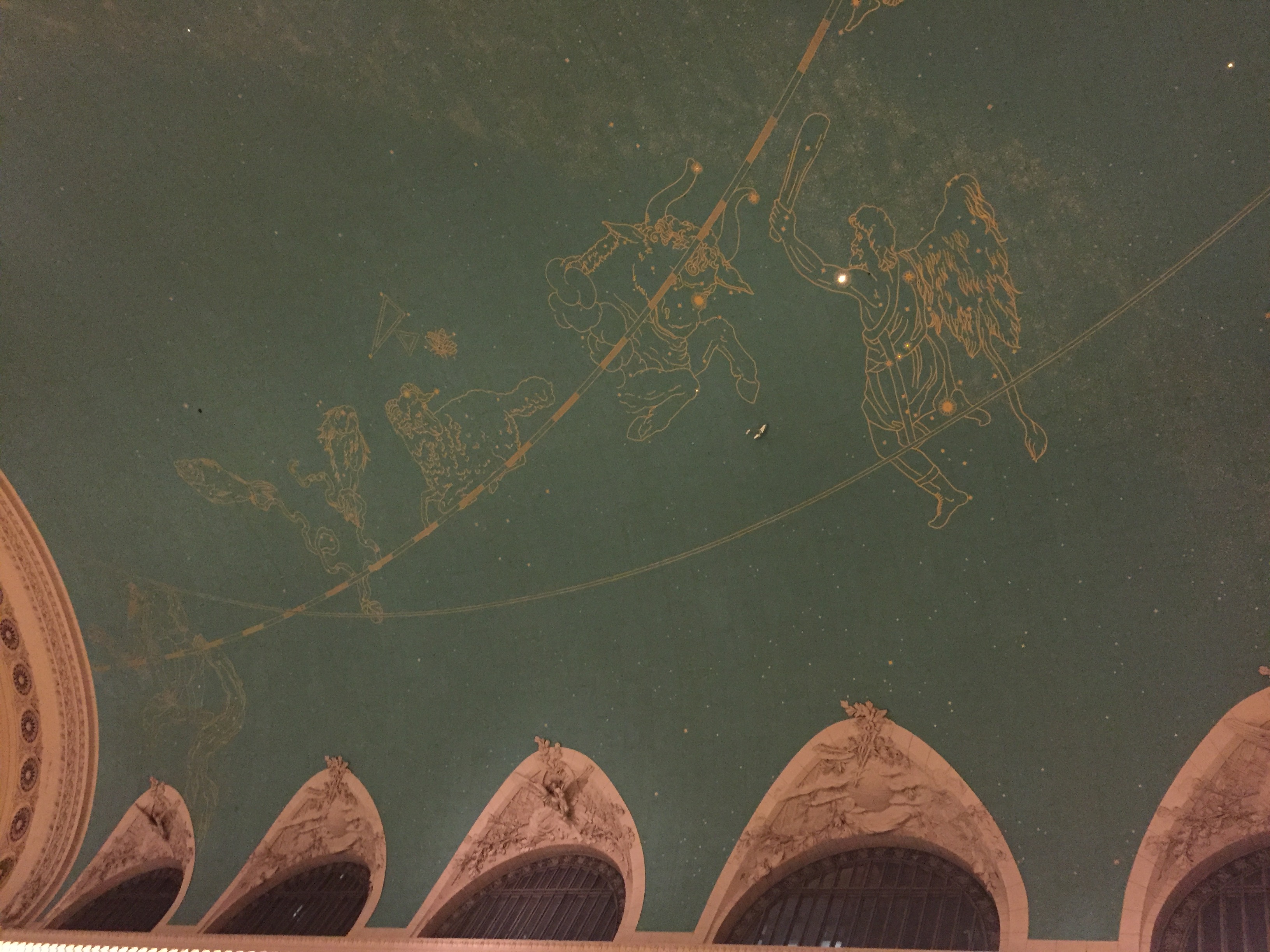
The starry ceiling was one of the artistic marvels of New York’s Grand Central Station when it opened in 1913. The constellations are based largely on Johann Bayer’s star atlas Uranometria (1603), which is the first Western atlas to cover the entire celestial sphere. Astronomically the Grand Central atlas is reversed from East to West and it was widely believed to be a mistake made when the artists transferred to the ceiling the draft provided by Columbia University’s Harold Jacoby, professor of astronomy. While some had argued that this corresponded to the ancient practice of representing the Heaven from without instead of from within, a commemorative postcard which is supposed to represent the original design indicated that the constellations were indeed painted backward.

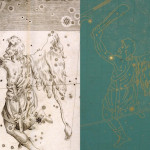
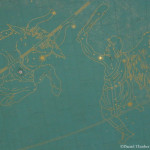
The atlas contains also a number of additional quirks which are of historical and general curiosity: (non-)reversion of Orion, the Triangulum Minus (non-standard constellation) was added during the 1945 restoration, and the hole above Pisces left from the time when the Redstone missile was exhibited in the Main Concourse in 1957, after the Soviet Sputnik was launched in the same year.

Photos 1: Grand Central Terminal celestial ceiling. The ceiling shows “left-to-right” from Aquarius to Cancer (here only to Orion, below Taurus).

Photo 2: Comparison of Orion with that of Uranometria (from Daniel Thurber, Untapped Cities)

Photo 3: Commemorative postcard from the “New Grand Central Terminal”