
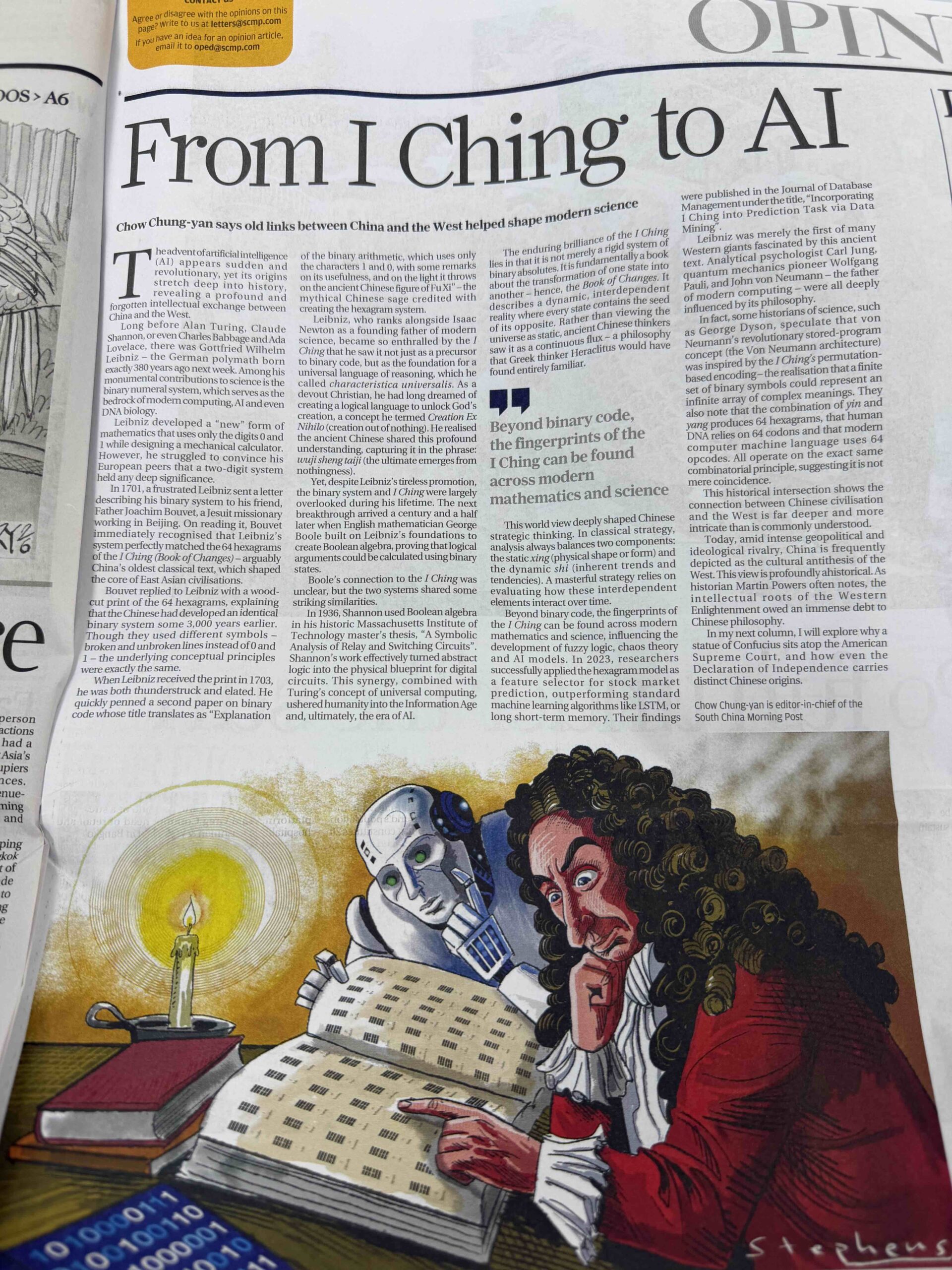

Bill M. Mak’s comments (SCMP 1 Jul 2026) on an SCMP article (23 Jun 2026), which suggests that many modern and Western inventions owe their origin to ancient China, citing the I Ching and binary arithmetic as one example.
I am writing in response to the article “From I Ching to AI”. While the idea that “the connection between Chinese civilisation and the West is far deeper and more intricate than is commonly understood” is broadly correct, there is no evidence that the I Ching played a role in the invention of Gottfried Wilhelm Leibniz’s binary arithmetic.
As the article itself noted, Leibniz had already developed binary arithmetic (by 1679) before he learned about the I Ching hexagrams (sometime between 1701–1703). Historians of science have clarified this point over the past century.
The impression that the Chinese hexagrams are connected to Leibniz’s invention originated largely from Leibniz’s own presentation of the subject in 1703, as mentioned in the article.
The extraordinary episode and subsequent misunderstanding are discussed in the second volume of Joseph Needham’s monumental Science and Civilisation in China. While Leibniz and Joachim Bouvet assumed that the Chinese had an understanding of binary arithmetic that was later forgotten, the hexagrams do not necessarily “embody an understanding of place-value and zero”, as Needham noted. Contemporary historians of mathematics generally agree that the Chinese never consciously invented binary arithmetic.
What is certain is that the I Ching influenced the way Leibniz later understood, promoted and philosophically interpreted binary arithmetic, but it was not the source of his mathematical idea. Such ideas emerged from a broader intellectual project concerning “universal science” and “universal language” among a number of 17th century European thinkers, including Francis Bacon and John Wilkins. John Wilkins’ famous An Essay towards a Real Character and a Philosophical Language (1668) sought a universal writing system partly inspired by European understandings of Chinese characters. Leibniz’s interest in Chinese writing and the I Ching should be understood within this broader intellectual context.
From the Chinese perspective, the Chinese never actually developed binary arithmetic. Crucial to the history of European mathematics is the widespread use of Hindu-Arabic numerals. Indian numerals including the symbol for zero were introduced into China as early as 718 through the Jiuzhi li (Treatise of the Nine Seizers). The Chinese never adopted them. Instead, Chinese mathematicians developed sophisticated arithmetic and algebra largely independently up to the 13th century, using Chinese characters and an intricate system of numerals inspired by the counting rods.
Chinese contributions to human civilisation and to modern science and technology are numerous, from the well-known compass, gunpowder, paper and printing, to the less well-known ones such as stirrups, smallpox inoculation and blast furnaces, as Joseph Needham brilliantly demonstrated in Science and Civilisation in China. Unfortunately, Leibniz’s binary arithmetic is not one of them.
Bill M. Mak, research associate, Needham Research Institute
SCMP article (23 Jun 2026)
https://www.scmp.com/opinion/china-opinion/article/3357612/i-ching-leibniz-and-ai-how-old-china-west-links-shaped-modern-science?module=inline&pgtype=article
Mak’s opinion (1 Jul 2026)
https://www.scmp.com/opinion/letters/article/3358828/want-family-friendly-hong-kong-start-allowing-unfolded-prams-buses?module=top_story&pgtype=subsection