In this temple, one finds also various Chinese elements which were likely added later. These include Chinese deities, most notably the guardian god and the twelve animals which representing the twelve directions.
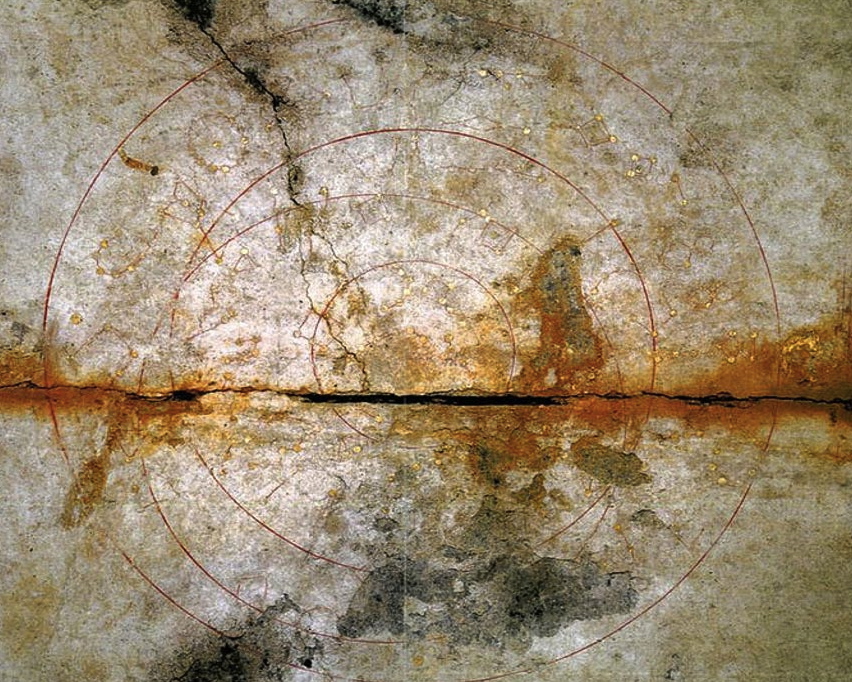
Although depictions of stars and constellations are found in Egyptian pyramids and Chinese tombs, and that the Chinese and possibly the Greeks had produced star maps centuries before the common era, the oldest extant specimens of a star map are dated to the 7th century, found in two rock tombs discovered 1972 and 1983 in Asuka, Japan (south of Kyoto).
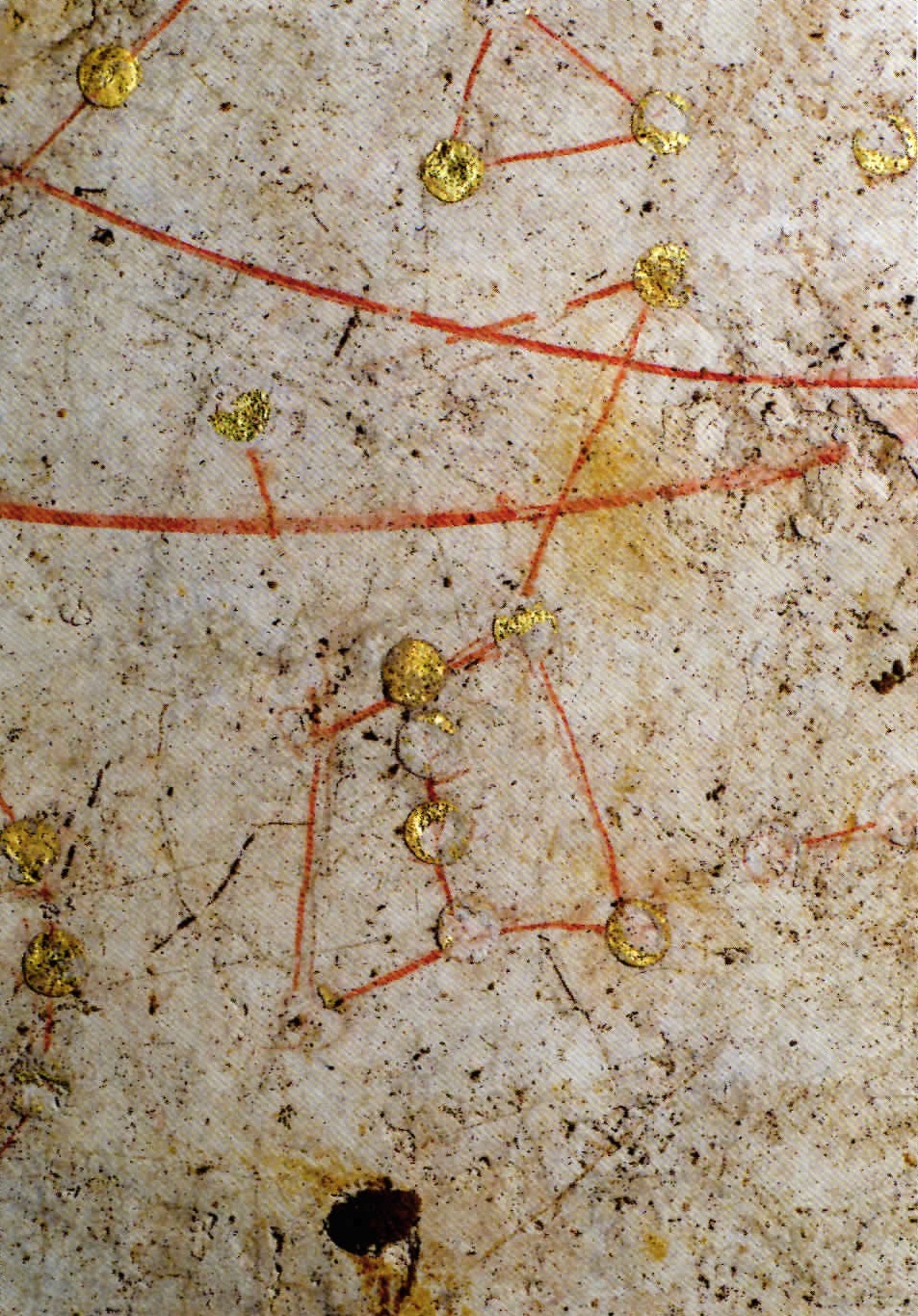
The Kitora star map is remarkably realistic, with c. 350 stars painted in gold, surrounded by 28 lunar mansions and the four mythical cardinal Chinese beasts. The map contains also three circles representing the minimum and maximum stellar visibility, the equatorial and an ellipse representing the ecliptic. What is surprising about these circles is that they represent a sky visible not in Asuka where they are found, but at 38.4 N (or 37.6 N), pointing to Korea.
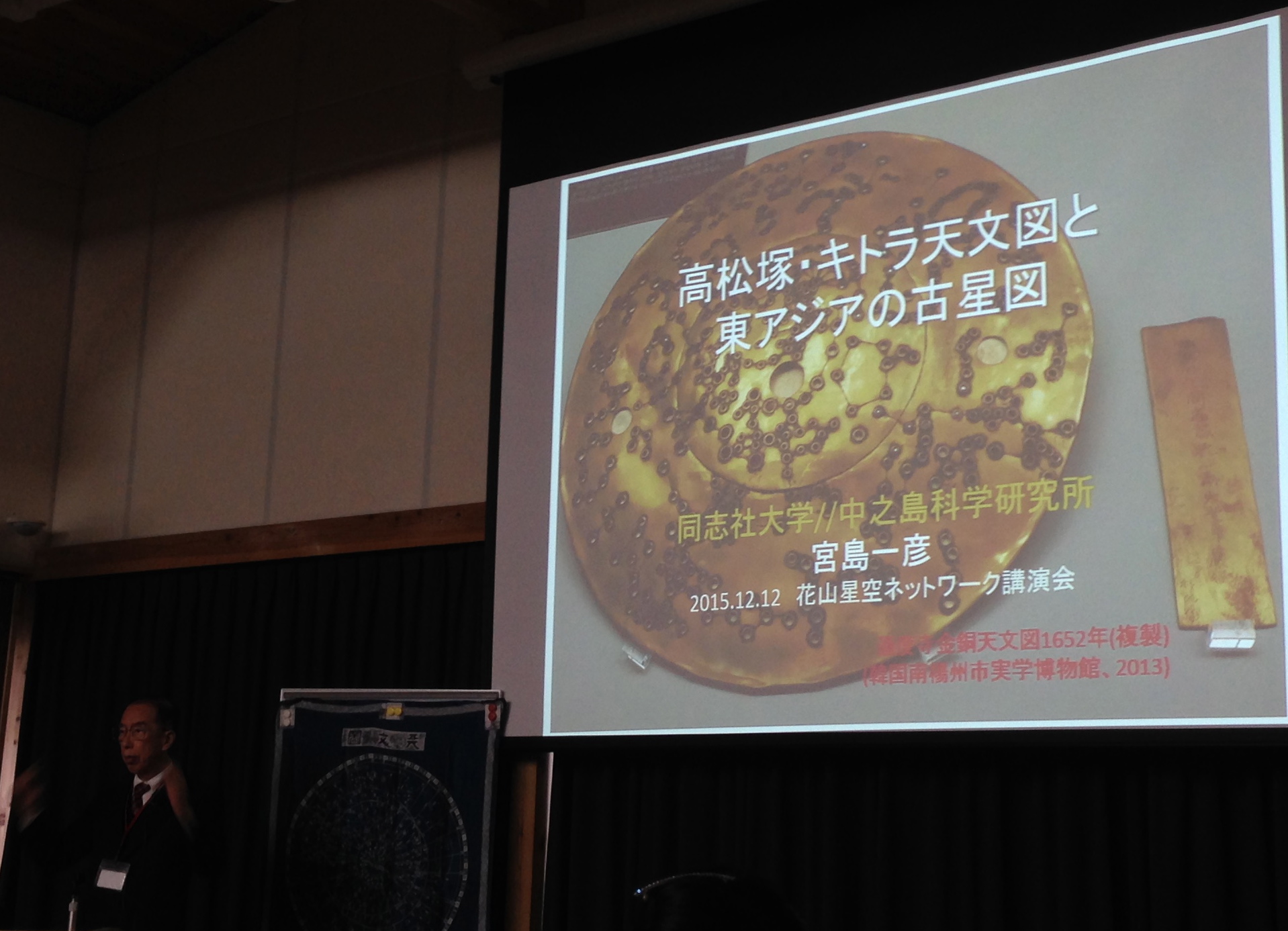
Prof. Miyajima Kazuhiko of Doshisha University explained his findings in a lecture (Kyoto University, 2015.12.12) and demonstrated the transmission of astronomical knowledge from China to Japan, and in some cases, via the Korea kingdoms as demonstrated by these remarkable star maps found in the Asuka tombs.
Prof. Miyajima’s lecture at Kyoto University (2015.12.12)
Chinese asterism shen 參 = Orion (note equatorial and ecliptic)
References:
宮島一彦. 2010.「万葉人の見た星空ーー高松塚・キトラ古墳 天文図の世界」. 『奈良学・やまとみち』
山本忠尚. 2010.『高松塚・キトラ古墳の謎』.
百橋明穂. 2010. 『古代壁画の世界 : 高松塚・キトラ・法隆寺金堂』.
網干善教. 2006. 『壁画古墳の研究』. 東京: 学生社.
宮島一彦. 2004. 「キトラ古墳の天文図は平壌の空」.『理戦』 78:46-61.
Nepal is one of the very few countries that have Saturday as holiday and Sunday as working day. Another country would be Israel where Sabbath is observed on Saturday. According to some sources, Saturday became official rest day during Rana Dynasty, under the order of Shrī Tīn Bhim Shumsher Jung Bahadur Rana in the 1930s. But why Saturday and not Sunday as rest day? Some of my Nepalese friends jokingly suggested that because Saturday is astrologically inauspicious (śanaiścara) so it is better not to work. Some sources claimed that it is a Vedic convention, which is certainly groundless because the concept of week is not found in the entire Vedic corpus. While Saturday as a rest day is unheard of in India and other neighboring countries, the reason is probably more straightforward. In the Indian astral tradition, the seven planets always begin with the Sun. The week begins therefore with Sunday and end in Saturday. Placing the Saturday as the weekend, literally end of the week, makes perfect sense and Sunday is of course the first working day. Nepal was simply faithful to the original design of the concept of the week, although technically speaking, the planetary week should start with Saturn and not the Sun!
The Newari saptavāra deity for Saturday is Grahamātṛkā and is paired up with Uttaraphalgu(nī) as shown here in the woodcarving in Chusya Baha, Kathmandu.